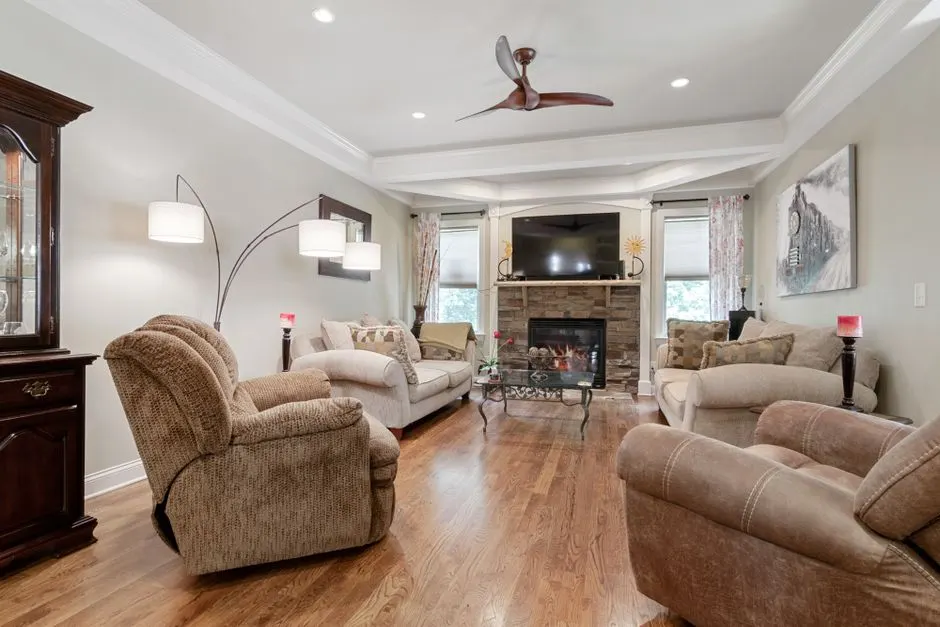
Installing a ceiling fan on a vaulted ceiling means adding a downrod long enough to clear the slope, mounting it to a fan-rated box that is secured to structure, and running the wiring so the fan hangs level and does not wobble. The install itself is not complicated, but the parts list is different from a flat ceiling, and that is where most do-it-yourself jobs go wrong.
We are Fall River RapidSpark Electrical, and we have hung fans on everything from 8-foot flat ceilings in the Highlands to 14-foot cathedral ceilings in Globe Village. This guide walks you through the downrod math, the mounting hardware, the wiring, the 2026 costs in Fall River, and the mistakes that turn a two-hour job into a weekend project.
Why a vaulted ceiling changes the whole install
A vaulted ceiling fan installation in Fall River MA is different from a flat-ceiling job because the fan has to hang from a sloped surface and still sit level in the room. On a flat ceiling, the fan mounts directly to a box that sits flush with the drywall. On a vaulted ceiling, the fan needs a downrod to drop below the peak, plus a canopy or ball-and-socket mount that can absorb the slope angle.
There are three things that change:
- Downrod length. The fan has to clear the slope by at least 7 to 10 inches on the low side, or the blades will hit the ceiling when they spin.
- Mounting angle. Most fans ship with a canopy rated for up to 30 degrees of slope. Steeper ceilings need a sloped-ceiling adapter or a cathedral mount.
- Box support. A fan-rated box has to be anchored to a joist or a metal brace rated for the fan's weight and the torque it produces. A standard light box will not hold a fan.
The good news: once you know the pitch and the downrod length, the rest of the job follows the same steps as any other fan. If you would rather not climb a ladder on a 12-foot slope, our team handles ceiling fan installation Fall River MA with the right hardware on the truck, so you are not making three trips to the store.
Sizing the downrod for your ceiling pitch
The downrod length for a vaulted ceiling in Fall River depends on the ceiling height at the peak and the slope angle. The rule we use is simple: measure the ceiling height at the peak, subtract the fan's recommended clearance (7 feet from the floor for standard blades, 8 feet for high-volume fans), and add 6 to 12 inches for the slope.
Here is the math in plain terms. If your ceiling peaks at 12 feet and you want the fan at 9 feet, you need a 3-foot drop. But because the ceiling slopes, the fan also has to clear the low side of the slope. On a 30-degree pitch, a 36-inch downrod usually clears a 12-foot peak with room to spare. On a 45-degree pitch, you may need 48 to 60 inches.
Downrods come in standard lengths: 12, 18, 24, 36, 48, 60, and 72 inches. You can buy a longer rod and cut it down, but you cannot stretch a short one. Measure twice.
One more thing: longer downrods need a stabilizer or a ceiling fan brace to stop the fan from swaying. A 60-inch rod on a 14-foot ceiling will move more than a 12-inch rod on an 8-foot ceiling. We see this a lot in the older triple-deckers around Globe Village, where the ceiling is high and the fan is heavy. If the wiring in the ceiling is old, that is a separate issue - our electrical wiring repairs Fall River MA team can check the circuit before we hang anything.
Mounting hardware: what a sloped ceiling actually needs
Cathedral ceiling fan installation Fall River MA jobs live or die on the mounting box. You need a fan-rated box, not a light box. The box has to be listed for fan support, which means it is stamped with the fan weight rating and anchored to a joist or a brace that spans two joists.
On a vaulted ceiling, the box sits on the sloped surface, so the fan's canopy has to be able to rotate to match the angle. Most fans include a ball-and-socket mount that handles up to 30 degrees. If your ceiling is steeper, you need a sloped-ceiling adapter kit. Those kits run $15 to $40 and are sold separately.
Here is what we check before we drill:
- Is there a joist behind the drywall at the peak? If not, we install a metal brace between two joists.
- Is the box rated for the fan's weight? A 50-pound fan needs a box rated for at least 50 pounds, plus a safety margin.
- Is the canopy angle correct? If the fan hangs crooked, the blades will wobble and the motor will wear out early.
If you are also upgrading the lighting in that room, this is the moment to do it. We often pair a fan install with recessed lighting installation Fall River MA so the ceiling gets one clean electrical visit instead of two.
Wiring the fan on a vaulted ceiling
Wiring a ceiling fan on a vaulted ceiling is the same as wiring one on a flat ceiling, with one extra step: you have to fish the wire through the downrod and the canopy before you hang the fan. The downrod is hollow, so the wires run inside it. If you forget to thread them first, you will be taking the fan down again.
Standard fan wiring is three conductors plus ground: black (hot), white (neutral), green or bare (ground), and often a blue or red for the light kit. If the fan has a remote, the receiver goes in the canopy. If it has a wall control, you need a switch leg with constant power and a separate switched leg for the light.
Two code points matter here. First, the box must be grounded. Second, if the fan is in a bathroom or near a sink, it needs GFCI protection. We install GFCI outlet installation Fall River MA all the time for that reason, and it is a cheap add-on while the ladder is already up.
If the ceiling has old knob-and-tube wiring, do not tie a modern fan into it. The insulation is brittle, the circuit may not be grounded, and a fan motor draws more current than a light bulb. That is a job for knob and tube wiring replacement Fall River MA before the fan goes up.
How much does vaulted ceiling fan installation cost in Fall River?
Typical 2026 pricing for vaulted ceiling fan installation in Fall River runs $250 to $550 for a standard swap, and $600 to $1,200 if we have to run a new circuit, install a brace, or add a wall control. The fan itself is separate: budget $80 to $400 for the fan, and $20 to $60 for a downrod if the one in the box is too short.
Here is a rough breakdown:
- Basic swap on an existing fan-rated box: $250-$350.
- New box and brace on a slope: $350-$550.
- New circuit from the panel: add $300-$600.
- Wall control or remote wiring: add $75-$150.
We quote the job before we start, and the price does not change because the ceiling turned out to be steeper than it looked from the floor. If the fan is already up and just stopped working, that is a different call - our ceiling fan repair Fall River MA service handles motors, capacitors, and remote receivers.
Common mistakes we see on vaulted ceiling fan installs
The mistakes we fix most often on vaulted ceiling fan installs in Fall River come down to three things: wrong box, wrong downrod, and wrong angle. Here is what to watch for.
- Using a light box. A plastic light box will crack under the torque of a fan. Always use a fan-rated box.
- Cutting the downrod too short. If the blades come within 7 inches of the slope, the fan will wobble and the motor will overheat.
- Ignoring the canopy angle. A fan that hangs crooked puts uneven load on the bearings. It will hum within a year.
- Not balancing the blades. Even a perfect install needs a blade-balance kit. It takes five minutes and stops 90 percent of wobble complaints.
- Tying into an ungrounded circuit. If the box has no ground, the fan can shock you when you touch the pull chain.
One more: do not hang a fan from a ceiling that is not structurally sound. If the drywall is soft or the joist is cracked, fix that first. We see this in older homes near the waterfront, where humidity has done a number on the framing.
When to call a professional
Call a professional when the ceiling is steeper than 30 degrees, when there is no existing fan-rated box, when the circuit is old or ungrounded, or when you cannot safely get a ladder to the peak. A vaulted ceiling fan install is a two-person job on a 14-foot slope, and one wrong step is a hospital visit.
We handle the whole job: downrod sizing, box and brace, wiring, wall control, and blade balancing. If you want a fan that runs quiet and does not wobble, our team can get it done in a single visit. For everything from panel work to lighting, we are the Emergency Electrician Fall River MA homeowners call when they want it done right the first time.
Frequently Asked Questions
How do I install a ceiling fan on a vaulted ceiling in Fall River?
Measure the peak height, pick a downrod that clears the slope by 7-10 inches, mount a fan-rated box to a joist or brace, thread the wires through the downrod, and hang the fan with a canopy rated for your ceiling angle. If the pitch is over 30 degrees, use a sloped-ceiling adapter.
What downrod do I need for a vaulted ceiling in Fall River MA?
For a 12-foot peak with a 30-degree slope, a 36-inch downrod usually works. For a 14-foot peak or a 45-degree slope, plan on 48-60 inches. Measure the low side of the slope, not just the peak, and leave 7-10 inches of clearance.
Can I install a ceiling fan on a vaulted ceiling myself in Fall River Massachusetts?
Yes, if the ceiling is under 30 degrees, there is already a fan-rated box, and the circuit is grounded. If you need a new box, a new circuit, or you are working above 10 feet on a slope, hire a licensed electrician. The ladder work is the risky part.
How much does vaulted ceiling fan installation cost in Fall River?
In 2026, expect $250-$550 for a standard install on an existing box, and $600-$1,200 if we run a new circuit or add a brace and wall control. The fan and downrod are separate. We quote the full job before we start.
Do I need a special box for a ceiling fan on a vaulted ceiling?
Yes. You need a fan-rated box anchored to a joist or a metal brace. A standard light box is not rated for the weight or torque of a fan and can fail. The box also has to be grounded for safety.
Get help with Emergency Electrician in Fall River
If your vaulted ceiling fan needs a downrod, a new box, or a circuit that can handle the motor, we can take care of it. We serve Fall River and the surrounding towns with same-day scheduling and upfront pricing.
Call Fall River RapidSpark Electrical at (508) 446-9335 and we will get your fan hung level, quiet, and safe.